
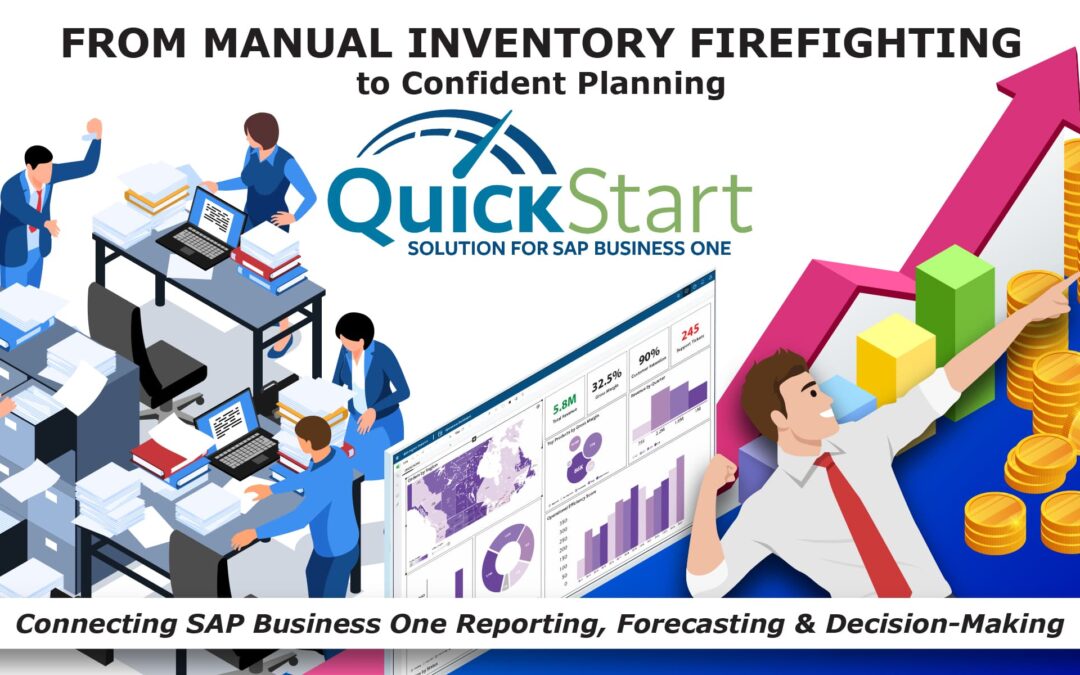
What one supply chain conversation revealed about connecting SAP Business One reporting, forecasting, and decision-making.
I recently had a 90-minute working session with a supply chain leader at a growing food distribution business. The conversation was candid and practical. Less about “analytics features” and more about what teams are actually dealing with day to day: inventory visibility that lives in too many places, forecasting that depends on spreadsheets, and decisions that feel urgent because the signals arrive late.
What stood out most was how common the underlying challenge is. Many organizations running SAP Business One already have the data they need, but turning that data into consistent reporting, usable forecasting, and cross-team alignment is where the real gap exists. That’s exactly the type of gap we help close at NewIntelligence: connecting operational reality to decision-ready insights and repeatable planning using the QuickStart Solution for SAP Business One, powered by IBM Cognos Analytics and IBM Planning Analytics.

The Inventory Challenge isn’t “data”, it’s Visibility and Time
If you’ve worked in supply chain or operations, you’ve seen the pattern:
- Inventory is technically in the system, but visibility is fragmented across screens, exports, and spreadsheets
- Stockouts are discovered late (often by sales, customers, or the warehouse)
- Purchase orders, sales trends, and demand signals exist, but connecting them takes manual work
- Teams spend more time building reports than making decisions
In this case, the leader described a familiar reality: too much time spent tracking and reconciling information, and not enough forward visibility to plan confidently.
What changes when SAP B1 data becomes easy to use?
The turning point in the discussion wasn’t “more reporting.” It was the ability to bring the right operational signals together, inventory movement, demand trends, purchasing status, and service levels, in a way business users can actually explore.
- A structured, proven analytics foundation for SAP Business One
- Dashboards and reporting built around how teams operate (not how tables are stored)
- A platform that can be extended as requirements evolve
QuickStart comes with three tiers out of the box, Operations, Financial Reporting, and Budgeting & Forecasting, and 30+ purpose-built modules. So teams can start with what matters most and expand from there.
Inventory + Demand Forecasting: Where the real leverage is
When inventory is under pressure, the question isn’t just “what do we have?” It’s:
- What will we need next?
- Where are we likely to stock out?
- What should we buy and when?
- Which products are trending up or down, and why?
QuickStart supports this with operational building blocks designed for real execution: modules such as Inventory, Purchasing, Available to Sell, Warehouse Picking, Landed Cost Analysis, and Demand Forecasting for Inventory Management. Instead of stitching answers together from multiple exports, teams get a consistent view of what’s happening and what’s likely to happen next.
The outcome is a shift from reactive firefighting to proactive planning.
Analytics business users can actually explore (without waiting on IT)
A key theme from the call: reporting only helps if people can use it.
With IBM Cognos Analytics powering QuickStart, teams can move beyond static reports into interactive exploration:
- Dashboards that surface operational and financial drivers (sales, margin, fulfillment, freight, inventory turns)
- Drilldowns and filters that help users answer “why did this change?” in seconds
- AI-assisted capabilities that speed up insight discovery (recommended visualizations, narrative insights, and forecasting with confidence intervals)
And for organizations that care deeply about governance and compliance: the Cognos Analytics Assistant is not generative AI. It supports natural-language style questions and guided insight features, while operating within the organization’s environment.
Planning and Forecasting that isn’t trapped in spreadsheets
The conversation eventually landed where most supply chain and finance leaders end up: planning.
Forecasting isn’t just a supply chain problem, it’s a coordination problem across:
- Sales assumptions and demand patterns
- Purchasing and lead times
- Inventory strategy and service levels
- Finance targets and margin expectations
This is where IBM Planning Analytics expands the value:
- Forecasting based on historical patterns plus business logic
- Scenario modeling and what-if planning (best case / expected / worst case)
- Faster, more controlled budget cycles with fewer manual roll-ups
- A clearer connection between operational reality and financial plans
When planning becomes structured and repeatable, teams stop debating whose spreadsheet is right—and start aligning around decisions.
Why “pre-built + adaptable” Matters
Most organizations don’t want a blank canvas. They want something proven that still fits how they operate.
- Pre-built modules provide a strong foundation quickly
- Customization is available to match unique workflows, KPIs, and forecasting approaches
- The system can evolve without forcing a complete rebuild later
Conclusion: The Real Win Is Confidence
Conversations like this are a good reminder that “better reporting” isn’t the end goal. The goal is confidence. Knowing what’s happening in operations, understanding what’s likely to happen next, and being able to plan and respond without rebuilding spreadsheets every week.
At NewIntelligence, our work typically starts with clarity: a reliable view of inventory, demand, purchasing, and performance that business users can actually use. From there, forecasting and planning become less about guesswork and more about structured, explainable decisions that teams can stand behind. When that foundation is in place, organizations move faster, waste less time on manual effort, and make smarter calls across supply chain, finance, and leadership.
If your SAP Business One environment feels data-rich but decision-poor, we should talk. The path forward is usually not more tools, it’s a better system for turning the tools you already have into results.
